
Mission:
As a fitness industry 🔩 with particular interest in longevity (both the concepts of and the personal application factor!), increase my understanding of Heart Rate Variability (HRV):
refers to the variations in the time intervals between consecutive heartbeats
it is a measure of the body’s autonomic nervous system (ANS), which controls involuntary functions such as heart rate, breathing, and digestion
(SEE FULL AI OVERVIEW BELOW)
And figure out how much hydration and/or overtraining plays a factor in my own personal HRV health.
Wellness Why(s):
Primary: Physical
LIVE LONG AND PROSPERSubsidiary: Intellectual (increase my knowledge on the topic), Occupational (pass knowledge along)
The Nuts & Bolts:
An average HRV for my age group (36-45) is between 50 and 70 ms whereas my 7-day average is 32 ms 😳.
Per AI Overview, “you can still have a healthy HRV that’s lower than average, especially if you are an elite athlete,” but I don’t understand HRV enough to know if my low HRV is because I’m a fairly trained athlete OR if it is problematic.
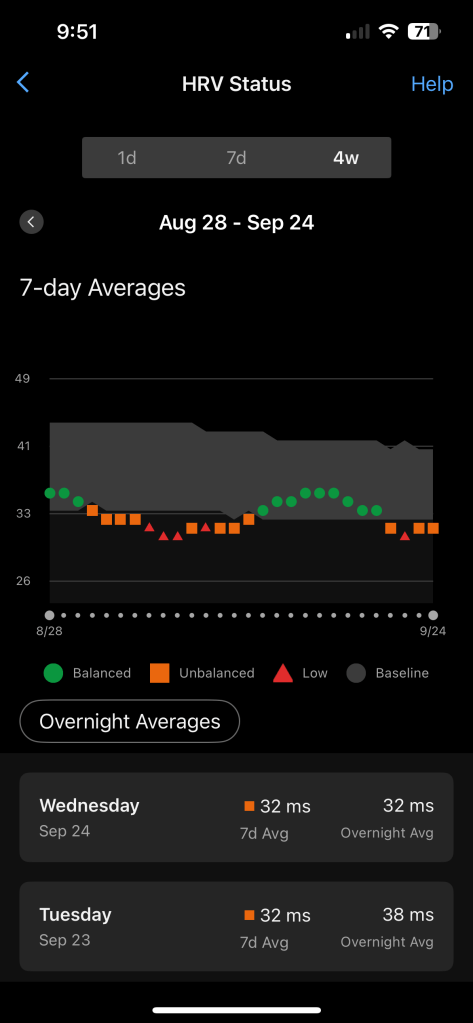
And I’d like to know 🧐 so as to delay the inevitable💀.
Step 1: Watch USAT Endurance Exchange Video “Beyond the Pulse: Optimizing Coaching with HRV Insights” that I’ve had access to for months and not yet taken advantage of.
Step 2: Hammer down on my hydration and electrolytes (which is also conveniently part of this week’s Weekly Wellness Plan) in order to rule out this factor as being a lowering factor.
Step 3: Compare my training load metrics to my HRV graph in order to rule out overtraining as being a lowering factor.

Step 4: Ask WizKid ChatGPT my questions that still aren’t answered.
Step 5:
Analyze – Adjust – Apply – Assess
Update On:
When/if I believe that YOU can live a longer life because of what I think I better understand.
AI Overview
Definition:
Heart rate variability (HRV) refers to the variations in the time intervals between consecutive heartbeats. It is a measure of the body’s autonomic nervous system (ANS), which controls involuntary functions such as heart rate, breathing, and digestion.
Importance:
HRV is an important indicator of overall health and well-being. Higher HRV indicates a more flexible and adaptable ANS, which is associated with:
reduced stress levels, improved sleep quality, enhanced cardiovascular health, and lower risk of chronic diseases
Measurement:
HRV can be measured using various methods, including:
Electrocardiogram (ECG)
Holter Monitor
Wearable Devices (fitness trackers, smartwatches)
Interpretation:
A higher HRV score generally indicates better health. However, the optimal HRV values can vary depending on factors such as age, gender, and fitness level.
Factors Affecting HRV:
Age: HRV tends to decrease with age.
Stress: Stressful situations can lower HRV.
Sleep: Poor sleep quality can lead to lower HRV.
Exercise: Moderate exercise can improve HRV, while excessive exercise can decrease it.
Medications: Certain medications can affect HRV.
Medical conditions: Some medical conditions, such as heart disease and anxiety, can alter HRV.
Improving HRV:
Engage in Regular Exercise
Get Enough Sleep
Manage Stress Effectively
Practice Relaxation Techniques (e.g., meditation, yoga)
Improve Diet
Avoid Caffeine and Alcohol Before Bed
Conclusion:
HRV is a valuable indicator of overall health and wellness. By understanding and monitoring HRV, individuals can take steps to improve their well-being and reduce their risk of chronic diseases. It’s important to consult with a healthcare professional for personalized guidance and interpretation of HRV measurements.
Note: The information provided in this response is for general knowledge and informational purposes only, and does not constitute medical advice.
 Kristine Joy, Writer
Leave a comment